Max Conway

Humanoid robotics — planning with learned models.

PhD student in Computer Science, University of Colorado Boulder.
Advised by Dr. Nikolaus Correll and Dr. Zachary Sunberg.

Résumé (PDF)
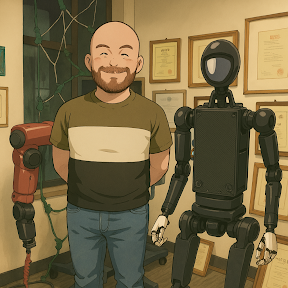
Portrait of Max Conway

About

I’m a PhD student in computer science at CU Boulder, advised by Dr. Nikolaus Correll and Dr. Zachary Sunberg. I work on humanoid robots that plan with learned models: building the autonomy stacks that let them do precise physical work, and studying how learned models of the world can make that planning robust.

Before Boulder I completed an M.S. and B.S. in computer science at the University of Denver, researched perception for autonomous robots at DEVCOM Army Research Laboratory, and interned as a software engineer at Amazon.

I’m open to employment and research collaboration. If you work on humanoid autonomy, planning under uncertainty, or getting robots to do real physical work, get in touch.

Research

GOLEM

Generalized Open Layered Embodied Modules

A modular, open autonomy stack that gets a full-size humanoid doing high-precision industrial work.

GOLEM runs ROS 2, MuJoCo, and Isaac Lab in separate containers over a shared CycloneDDS domain, so perception, control, and safety modules can be swapped and compared without rewriting the stack around them. On the Correll Lab’s Unitree H1 it drives OMPL arm motion planning at millimeter IK error, FAST-LIO SLAM with Nav2, and whole-body control trained in simulation — demonstrated removing screws from a Hyundai Ioniq 5 battery pack. I led the 17-person team that built it, and the architecture, both simulators, and every module are open source.

  • ROS 2
  • MuJoCo
  • Isaac Lab
  • Unitree H1
  • Docker
  • CycloneDDS
  • OMPL
  • FAST-LIO

RAPID

Robotic Agentic Platform for Intelligent Electric Vehicle Disassembly

A robot that takes a plain-language instruction and takes an EV battery pack apart.

A Universal Robots UR16e rides a linear gantry driven as a seventh joint, so the arm has a redundant degree of freedom and a workspace spanning a full Hyundai Ioniq 5 pack. A language-model agent turns a request like “remove all remaining parts” into concrete perception and motion calls. I designed and deployed the platform, owning motion planning, perception, and the mechanical design.

  • ROS 2
  • UR16e
  • LLM agent
  • Visual servoing
  • Motion planning
  • Docker

Forceful Skill Acquisition

Unfettered Forceful Skill Acquisition with Physical Reasoning and Coordinate Frame Labeling

Ask a vision-language model for forces rather than trajectories, and it generalizes to new manipulation tasks with no pretraining.

Overlaying a consistent view of the relevant coordinate frames onto the robot’s own camera images lets a VLM reason explicitly about wrenches. Across 220 experiments on two robot platforms — opening and closing a lid, pushing a cup and a chair — the framework reached 51% zero-shot success and could reason about interaction feedback to recover from failures. The paper also characterizes how embodied visual prompting can bypass a VLM’s safeguards.

  • Vision-language models
  • Force control
  • Zero-shot manipulation
  • Visual prompting
Media coming soon

Planning with Learned World ModelsWork in progress

Hypothesis: world models built over temporally extended options instead of individual actions will suffer less from compounding error, enabling longer-horizon planning.

Ongoing PhD work at CU Boulder with Dr. Zachary Sunberg and Dr. Nikolaus Correll.

Updates

Teaching

Publications